Systemic risk is a risk that not only cascades but also leads to a systemic failure through circular causality, feedback loops, and non –linear emergence of collapse.
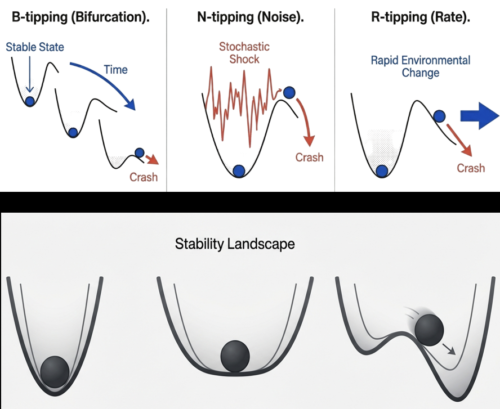
Collapse is a product of “self-organized criticality” as a result of:
- Rapid system simplification, due to inefficient, extensive system complexity,
- Lack of adaptive capacity of the system to environmental change or stressor (additional energy input)
- The rate of change that exceeds the system’s transformability and adaptivity for accommodating the impact of change
- Natural gravitation of the system toward critical transition, decay, and degradation
- Change in the landscape of stability
Recursive risk:
Recursive risk is a similar but different term from systemic risk. We define recursive risk as a risk that is not necessarily systemic but arises from a risk-reduction intervention, a risk that returns to the system with a magnitude equal to or greater than its initial state.
Recursive risk is the outcome of risk response as a negative impact in the future on the origin where the risk was treated, often by failing to understand the system and developing holistic responses. Recursive risk is realized by creating new vulnerabilities and exposures or by amplifying existing ones.
Systemic risk and collapse:
In many systems, collapses are not random but mathematically structured events governed by changes in the attractor basin or stability landscape. Collapse is when degradation becomes the path of least resistance. Energy and Multisatbility are the primary requirements for collapse.
PRI conducts research, advisory services, and training programs addressing conceptual and operational aspects of Systemic risk, recursive risk, and collapse.

PRI seeks to understand the modality of collapse and risk and develop actionable knowledge for real-world problems. We conduct research, provide advisory services, and offer training programs that address the conceptual and operational aspects of Systemic risk, recursive risk, and collapse.