The World Bank reports that nearly half of the projects evaluated failed to achieve sustainable outcomes, with malinvestment costing $40–60B annually (World Bank IEG, 2022). IPCC AR6 WGII (2022) report evidence that climate actions inadvertently increase vulnerabilities, create lock-ins, or worsen inequities. Similarly, 50% of DRR projects are likely to fail in reducing long-term risks.
Resilience measures are choices that involve interactions with the natural, technical, and social environments. As any other anthropogenic choices, they are not immune to bias, error, and failure. Thus, resilience measures can become detrimental to the natural, technical, and social environments. Those negative impacts are often foreseen and deemed marginal relative to the gains a resilience intervention yields. However, this is not always the case, which leads to negative systemic outcomes exceeding the local benefit of the resilience choice. We call this deseilince. For example, maladaptation is an instance of desilience when the “choice” is an action and remains within the climate change context. However, desielince goes beyond adaptation as it can be applied to development projects, interventions for social resilience, engineering design for infrastructure robustness, and negative outcomes of inaction or delayed actions.
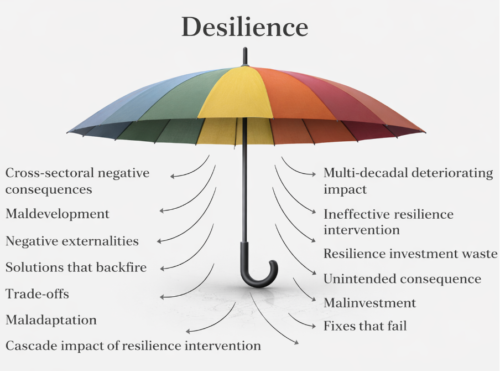
Desilience is not a synonym for maladaptation, nor a simple trade-off between competing goods. It occurs when investments not only waste but also push the system to lower resilience than the baseline resilience at the time of intervention, and the negative outcome or origin is beyond the context of climate change.
Desilience occurs when disaster risk reduction becomes disaster risk creation, when climate adaptation proves maladaptive, when sustainable development ultimately increases consumption or inequality, or when resilience measures exacerbate social injustice, ecotoxicity, biodiversity loss, habitat destruction, and waste.
Mechanisms of Desilience:
- Amplified Vulnerability
- Recursive vulnerability (resilience longevity)
- New vulnerability
- Shifted Vulnerability
- Shifting exposure
- Hazard leak
- Lock in adaptation
To Avoid Desilience:
A. Ex Ante & Ex Post Desilience Assessment — structured appraisal before any resilience intervention is approved, and rigorous evaluation after implementation
B. RE-MERCAL Framework — Resilience and Adaptation Monitoring, Evaluation, Reporting, Certification, Accountability, and Learning (RE-MERCAL): providing institutional architecture for systematic desilience detection and accountability
C. Training and Awareness-Raising — Actionable knowledge with acknowledgment of uncertainty and its salient communication, inclusive and multimodal science communication, incorporating all forms of knowledge, including local and indigenous knowledge