Our planet is approaching unprecedented critical tipping points, as demonstrated by experiencing biospheric dysbiosis, crossing several planetary boundaries, and various ecosystem collapses. This brings the planet to the verge of the sixth biotic crisis caused, for the first time in the last 2.5 billion years, by only a single species—us.
Planetary Resilience Governance (PRG) refers to a dynamic regime of coupled human-natural systems that gives rise to the emergence of just and systemic wellbeing across space, species, and generations within certain socio-ecological and operational limits. Within this regime, planetary resilience is the long-term, holistic, planetary-level net gain of the aggregated local-level resilience interventions.
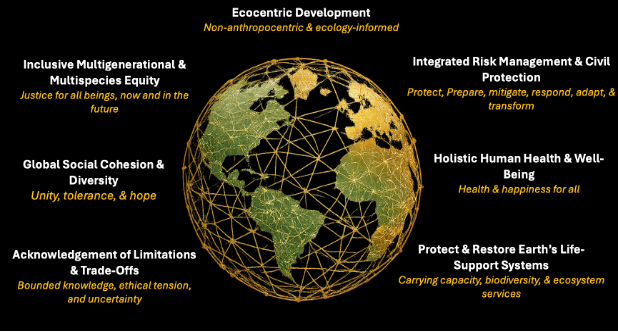
Moreover, Planetary Resilience Governance is concerned simultaneously with two fronts. First is building resilience into the ecosphere by preservation and restoration of its form and function that support ecosystem services, and second is building resilience into human settlements, by preparing communities for and protecting them from singular, multiple, and systemic risks, considering social, interspecies, and intergenerational equity and justice. Seven PRG principles are identified to navigate a compromise for the tension between stability and transformability of socio-ecological systems, as shown below:
Seven PRG Principles:
- Ecocentric development — A Gaia-centric, non-anthropocentric paradigm guided by the concept of one health and the integrity of the whole Earth system
- Integrated systemic risk management and civil protection — A comprehensive approach to de-risking resilience interventions and addressing systemic risks
- Protect and restore Earth’s life-support systems and regenerative capacity — Ecosystem restoration and conservation, maintaining the planet’s carrying capacity
- Inclusive Multigenerational and Multispecies Social Equity — Intergenerational and multispecies justice; inclusive, transboundary social cohesion
- Global social cohesion under heterogeneity of culture, opinion, and expression — A collective sense of bond and unity among people exhibiting extensive tolerance for disagreement
- Holistic human health and happiness for everyone — Global health as complete physical, mental, and social well-being for all
- Acknowledgment of constant feedback and trade-offs among principles — Constant trade-off within and among principles, conflicting values, and knowledge limitations
Planetary resilience governance does not acknowledge “Bouncing back” to an unjust or exploitative state and demands transformation away from growth-dependent structures. Planetary resilience aims to preserve the system’s core value rather than its status quo.
Unlike mainstream resilience, planetary resilience recognizes the material and energy throughput of resilience-building and its social burden. It takes into account the impact of local and sectoral resilience building on the global and long-term stability and well-being of all ecosystems. Furthermore, planetary resilience aims to preserve the system’s core value rather than its socio-economic status quo, thereby emphasizing the regenerative functioning of life-support systems and social equity as both means and ends for operationalizing the notion of “one life, one planet, and shared resilience”.
Planetary resilience is not an ideal state. It is a compromised solution to the best of our ability in understanding feedback loops, non-linear interactions, emergence, and bifurcations in the long run. The art in implementing planetary resilience is to find a compromise between transformability and stability at a rate that core system values are not eroded. Planetary resilience is a constant negotiation of conflicting values among actors, scales, and levels.